

She called to apologize
A story of exclusion and grace

Last week I released a new interview with pioneering transgender theorist Sandy Stone. Part of my mission in the interview was to understand the history of trans people being excluded, first by other women, now by the legal machinations of MAGA. This piece is about that question, and about how I came to interview a woman who took part in an action against Sandy long ago. The episode is embedded below or you can click here to listen on The Babblery.
It begins in the women’s community
It’s the early 70s, and Sandy Stone has realized in a hospital bed, recovering from a devastating accident, that she is a woman. At that time, it’s almost unthinkable for a transgender person to publicly admit who they are, much less medically transition. But Sandy goes ahead, and searching for a friendly place to land, she comes to Santa Cruz County, California. Here she meets a group of feminists who have formed a women’s community, lesbian and straight women, all cisgender. Improbably, they welcome her into the fold.
One day the founders of Olivia Records, a nascent label that will go on to record some of the most important women’s music of the period, walk into her stereo repair shop. They ask Sandy to be their recording engineer, and after making sure that they know that she’s transgender, she accepts.
Meanwhile, Nancy Vogl also knows she’s different. In her words, her upbringing has made her consider herself “pond scum, the evil, despicable soul of the world.” She knows a lesbian who has moved into a feminist collective home in Berkeley, so she leaves to find her own safe place to land. Soon she is integrated into the Berkeley women’s community. She moves in with her band, the Berkeley Women’s Music Collective, and blossoms.
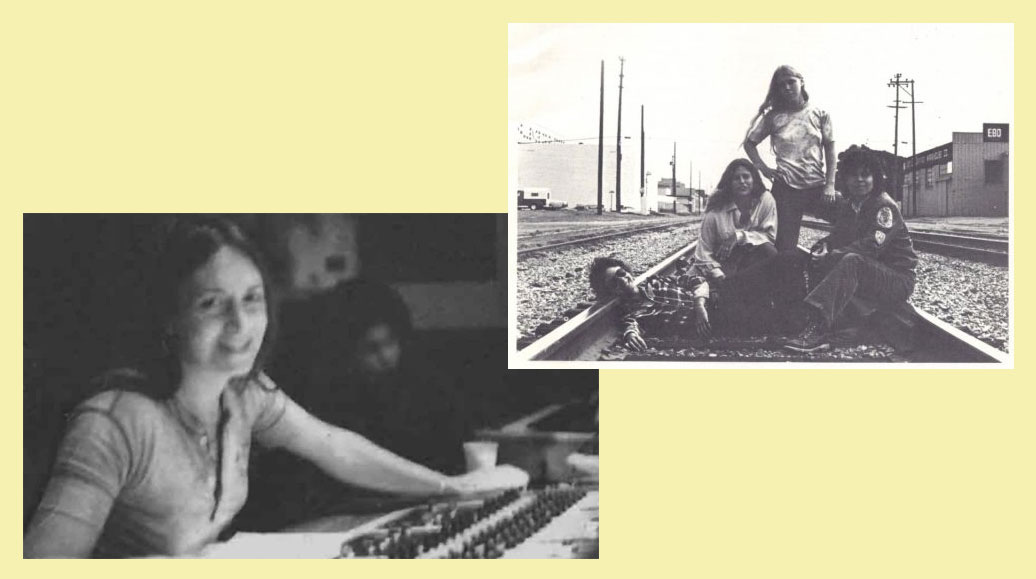
When Nancy’s band is connected with Sandy Stone to record their album, they are ecstatic. They have heard that Sandy has been successful in the industry, that she’s recorded Crosby, Stills, and Nash. The thrill of working with a woman engineer, at a time when women simply weren’t welcomed into that profession, was overwhelming. They recorded the album, Sandy remembering the young women as “these boisterous, just bumptious young women” who needed a lot of musical support. They parted happily.
This is where things got complicated. Sandy was the rare trans woman who easily passed as a cisgender woman, and she considers that a great gift in her life. But in this case, there was a problem: The young women of the Berkeley Women’s Music Collective somehow missed the news that the woman who recorded them, who had come to the women’s music scene after a successful mainstream career, was transgender.
At a meeting in the East Bay, Sandy was surprised to be confronted by Nancy, “standing on a chair screaming at me about how dare I ruin the women’s community.”
A brief history of TERFs
This wasn’t the first time that other feminists had attempted to exclude Sandy because she was transgender. Today, many people recognize the acronym TERF: Trans-Exclusive Radical Feminists. It has been applied, famously, to author J.K. Rowling1 and has become a verb. But in the 70s, there were so few out trans people, and the women’s community was so isolated from mainstream culture, that each situation was its own crisis.
After the public confrontation with the band, Sandy was not ejected from Olivia, and the Collective doubled down on their practice of inclusion. In a similar situation, two women in the Santa Cruz community forced a vote on whether Sandy was a woman (and lost: 48 to 2). In both cases, the women who tried to exclude Sandy clearly felt threatened that, to use a modern phrase, a “biological male” was in their midst. These days, TERFing has come into the mainstream, with Rowling taking part in Twitter wars and the Republicans working to exclude trans people wherever possible.
Drawn from a deep well
Before I looked more deeply into TERFing, I understood it as simple bigotry. But as anyone who has explored bigotry can attest, when you dig beneath bigotry you often find complexity: a deep well of hurt and fear. Nancy points out that as women joined feminist communities in the 70s, they brought with them and shared with each other great trauma at the hands of men—not just strangers but trusted men in their families and communities. Nancy says that they needed separatism not because of a fundamental hatred of men, but because they needed time to heal.
But TERFs who choose to believe that transgender women are fundamentally men are still with us today. TERFs still hold some the old ideas of exclusion, but now with strange bedfellows. These same women who came to exclusion largely from a place of trauma are now depending on the support of a deeply misogynistic MAGA culture to enact the legal remedies they seek.

The value of communication
I first spoke to Nancy when I called her about using music from her band, the Berkeley Women’s Music Collective, in an episode featuring writer Joan Gelfand’s memoir of the movement. I was impressed with Nancy’s thoughtfulness, and not surprised that in the interceding years she’s worked with queer youth. She was sensitive, open, and eager to tackle tough questions.
When I told Sandy I’d spoken to her, Sandy’s response was, “Do you know what she did to me? And do you know that she called me to apologize?” I was intrigued. I emailed Nancy to ask if we could record an interview. Nancy spoke to me so frankly, so movingly, and so thoughtfully about the women’s movement, about her own path, and about working with LGBTQ youth, that I knew she was the perfect person to pair with Sandy.
Both women describe that time beautifully, and though they come to their understanding of that moment and our current moment from very different points of view, they share a hopeful view of humanity that was salve for my aching soul.

Listen to the episode
This is a story about a transgender woman and angry women who wanted to exclude her. It’s a surprising and beautiful story told by women both characterized by a deep love for the community that nurtured them. I hope you can listen with a heart as open as theirs were when they spoke to me.
Listen on The Babblery podcast or press Play below.
Forthcoming: I’m working to put together more interviews with women who were involved in the 70s women’s movement to explore what was achieved then…and where we are now. Stay tuned.
The Babblery can use your support. Please comment on, like, and share this post. Recommend our publication to your friends. Become a paid subscriber. Buy us a coffee. Buy Wally and Tabitha some cat food. Listen to KSQD. Be awesome and carry on.
If you enjoy podcasts, please subscribe to the Babblery on your favorite podcast platform, including Spotify, Amazon, TuneIn, Apple Podcasts, and YouTube.

I highly recommend that anyone who finds this topic interesting listen to the podcast series, The Witch Trials of J.K. Rowling. It’s fascinating to listen to Rowling’s explanation for her positions, and the producers do a good job of contextualizing and offering the listener food for thought.
I don't see a transcript for the mini Babble here. Would love to read it.