

#MeToo meets due process
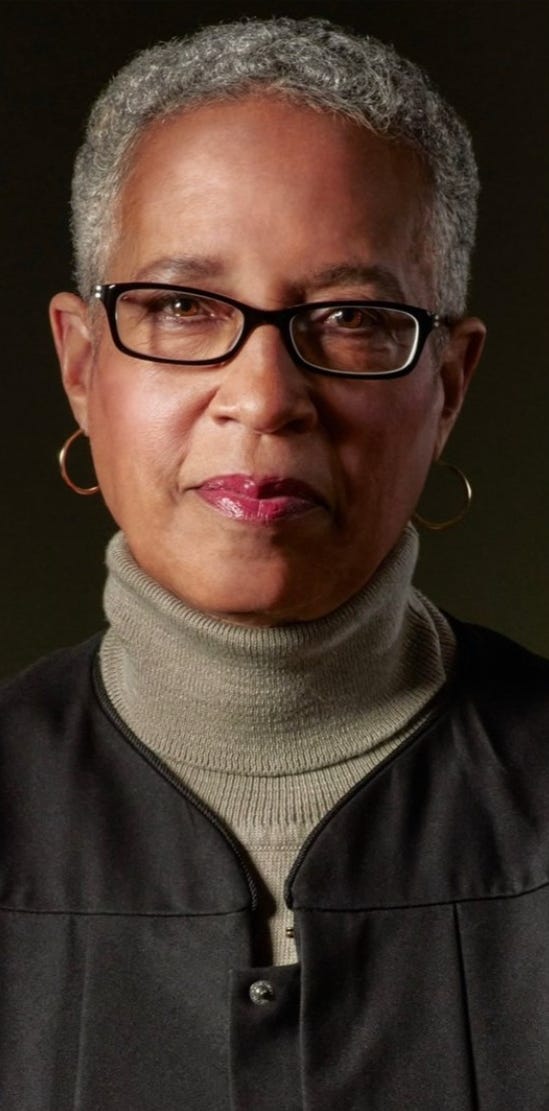
In conversation with retired Judge LaDoris Cordell

The #MeToo movement demanded justice for women. But for judges, justice is a process without shortcuts.
This is the text of a short audio piece—you can listen to the audio above or on The Babblery. Find my full episode interview with retired Judge LaDoris Hazzard Cordell at BABBLERY.com.
One woman and the law
LaDoris Cordell graduated from Stanford Law School, an impressive degree, but as a Black woman in the seventies, she could not get a job, so she started her own practice working in a historically Black town that had never had a resident lawyer. LaDoris took on every kind of case as a lawyer, and as a judge starting in 1980, she ruled on a wide variety of cases.
“I presided over every kind of case you can imagine,” LaDoris explains, “from adoptions to name changes to criminal cases, to people suing each other, to probate, to family court, to mental health where people are in like locked psychiatric units.”
LaDoris not only got to know wide areas of the law, but also got a front-of-the-courtroom view of human nature and how the law truly affects the lives of everyday people.
There is no single feminism
I asked her about feminism and she said she’d always been a feminist. But she explained that Black feminists have a difficult history with the movement. The most passionate part of her response was when we stepped into the #MeToo movement in 2017, where her support of feminism clashed with her deep belief in the structure of our legal system.
“When the whole MeToo issue came up and Harvey Weinstein, and I was out marching at that point,” LaDoris says. “I did, however, I’ll tell you my view quite frankly, that especially during the MeToo, that things went kind of over too far, where I had women saying to me, ‘we don’t care about due process.’ You know, once the accusation is made, just believe women.
“I’m like, excuse me. Hold up, move back.”
What do we hear when we hear “believe women”?
People hearing the phrase “believe women” tend to hear two different things. Many people, like me, heard a plea to stop discounting women’s testimony simply because they’re women, which I hope has improved at least a little bit since that time. But other people heard “believe all women” with the implication that women didn’t make false accusations or that men deserved whatever they got.
LaDoris knew otherwise on both counts. For years in her courtroom, she had watched human nature up close and she had come to realize that due process, the legal tenet that even guilty people deserved to be heard, was the only path to justice. But some feminists, fed up with not being listened to, were pushing back.
“And I’m not making this up. I’ve had women say this to me. You know what, what do you mean they should be heard? I said, excuse me, our system is built on opportunity to be heard and due process."
“And as a result of that, if that person has committed egregious behavior, then should be punished. But everyone has the opportunity. And I got this pushback, so it pushed me back, all right. It was like, you know what? You know, I’m just going to step aside here. And I watch, I mean, it just kind of went off, for me, off the rails."
“We just need you know, to keep in mind that there’s a system here that we should all be supporting. I don’t care who the heck it is. Due process, opportunity to be heard and everyone, it applies to everyone. You don’t just you know, hand pick people that should be allowed to have these principles or processes applied to them.”
The importance of due process
Our legal system is founded on a belief that factual truth matters. The principles were, of course, devised by white men whose reality was very different from ours. That creates a problem for a judge, whose job description doesn’t include adjudicating different belief systems.
“When you are in court and you take the witness stand, you raise your right hand and you swear to tell the truth, the whole truth, and nothing but the truth. So as a result of the women’s movement, particularly the more recent one, there’s this whole redefinition, which it just drives me crazy, of truth.
“It’s like, this is my truth. No, you don’t go and swear to tell your truth. No. So there’s a definition for truth. If you’re talking about my truth, it’s my belief, it’s my perspective. But we’ve so distorted the word truth.
“There’s truth. You know, it’s these little things and I guess, you know, it’s important to people, I guess to say, well, that’s my truth. I don’t even know what that means.”
What is truth?
I think LaDoris’s struggle to understand how people can redefine truth rests on the sloppiness of modern American language, as well as the complexity of the idea of truth itself. Is truth the same as facts? Or is truth based on a person’s perspective? Certainly the men who created the basis for our legal system by and large believed that a woman’s perspective was inconsequential.
Those men’s ‘truth’ was that women did not have the facility to speak for themselves. As much as we hoped that the MeToo era would improve women’s ability to be heard and believed, we’re still dealing with these questions of due process and defining truth today. Right now, accusations against long-dead men like Cesar Chavez are bumping up against real-time accusations against sitting politicians like Eric Swalwell.
Women are still not in agreement about the processes we should use to address past harms, and if we can’t agree on how to treat men who are long dead, how can we agree what to do when even the same facts lead to different expressions of truth?

She says, he says
My conversation with LaDoris reminded me of the complexity of adjudicating human interactions, where a man and a woman, Rashomon-like, may have lived two completely different stories that they both believed to be true. But the law doesn’t tell us whose belief to favor. It asks us to hear both sides out and make our best effort to find a just solution using the facts at hand.
Perhaps, with our culture so fragmented and fractious, we’re finding that we should ask, before we raise our right hand and swear, what truth really means.
Music: “Teeta” by Zenobia Powell Perry was performed by Deanne Tucker for the African American Composer Initiative.
The Babblery can use your support. Please comment on, like, and share this post. Recommend our publication to your friends. Become a paid subscriber. Buy me a coffee. Buy Wally and Tabitha some cat food. Listen to KSQD. Be awesome and carry on.
If you enjoy podcasts, please subscribe to the Babblery on your favorite podcast platform, including Spotify, Amazon, TuneIn, Apple Podcasts, and YouTube.

Something I was concerned about with #MeToo was human nature. If we automatically believe every woman who accuses any man, we are opening the floodgates to false accusations. Human nature says someone will accuse falsely for the money, the fame, retribution for something else. If in our push to ensure women are heard and cases are investigated instead of being shoved under rugs, we lose sight of the idea that women are human, we will have failed ourselves and the future.